
Theseus is a deterministic runtime for the systems that turn live data into decisions: trading books, energy networks, industrial sensors, autonomous devices. Your team defines the logic. Theseus handles orchestration, lineage, replay and change control, so a change ships the same day and you can replay any moment to prove exactly what ran.

Untested code pushed to production cost Knight Capital more than $460m in 45 minutes. Inadequate risk controls cost Citi a $400m fine. Different firms, one pattern: brittle orchestration, fragmented audit trails and slow change control.
Most stacks buy safety with process. Theseus builds it into the runtime: determinism, lineage and replay are properties of every execution.
The runtime enforces determinism at the execution layer, structurally rather than by convention or testing discipline. Identical inputs produce identical outputs regardless of environment, timing or concurrent load.
Every output carries the full record of what produced it: the inputs, the logic version and the trigger. Incident reconstruction that takes hours to days of log archaeology takes minutes, and audit evidence is machine-produced rather than rebuilt from memory.
Version, approve and roll out logic changes with governed self-serve. Permissions and approvals are built into the runtime, so change is fast without ever being unaccountable.
Target decision latency for qualifying production workflows.
Theseus Capital Markets runs the pricing and risk decision path for buy-side and sell-side desks on the Theseus runtime: real-time pricing, intraday risk, limits and market data transformation on one governed platform.
Live feeds, enterprise systems or simulated sources.
Small, versioned functions in the languages your team writes.
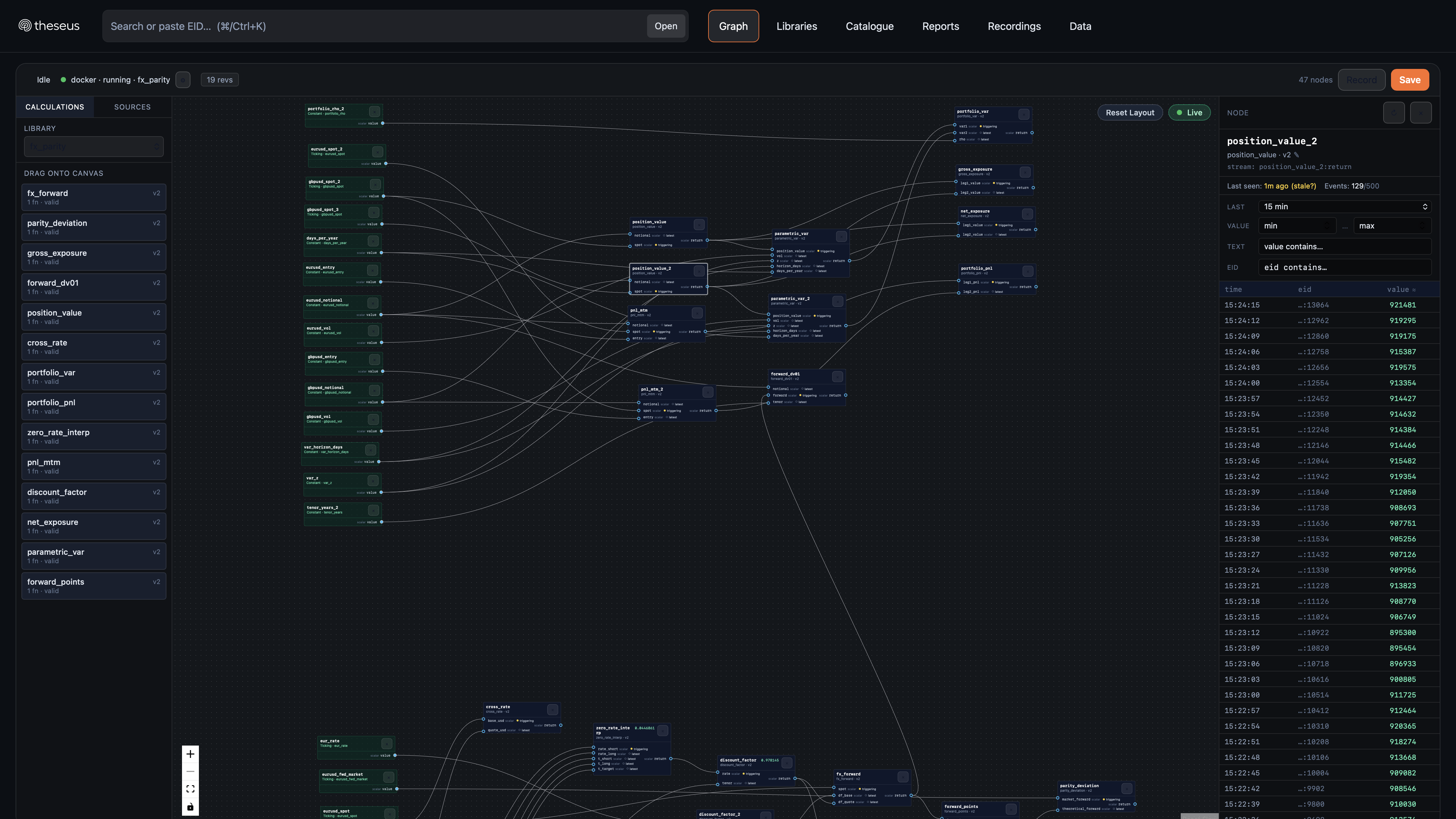
Link data to logic in a visual graph.
Dashboards and reports on any node, adapted by the people who use them.
We are onboarding design partners. Theseus Capital Markets runs in parallel with your existing systems, so there is no production risk, and the pilot reports three numbers: decision latency, change lead time and audit completeness against what you run today.