
Theseus provides the properties mission-critical logic needs as runtime primitives: determinism, lineage, replay, orchestration and governed change control. Your team defines the modules. The platform does the rest.
Live inputs from enterprise systems, market data feeds, sensors, events and APIs are captured with timestamps as they enter the runtime. Provenance is preserved from the first moment. Nothing is inferred, interpolated or silently dropped.
Logic is expressed as modular, versioned units: rules, models, workflows, triggers. Multi-language support through WebAssembly means teams write in the language they know, while execution happens in one controlled runtime that guarantees deterministic behaviour. Same inputs, same outputs, regardless of environment or timing.
Operational outputs, from metrics and decisions to alerts, signals and API calls to downstream systems, are produced with full lineage attached. Every output traces to the exact logic version and input set that generated it.
Lineage is not a log you reconstruct after the fact. It is a structural property of every execution. Inputs, logic version, trigger and output are linked automatically, so audit evidence is machine-produced and available immediately.
Calculations run as sandboxed WebAssembly modules inside a single runtime that owns scheduling, event ordering and every input a module can observe. Nothing reaches your logic except through the recorded event stream, so there is no wall clock, thread timing or hidden I/O to diverge on. Every run is journaled, and any recording can be re-executed and checked for identical outputs. The guarantee is verified on real runs, not asserted.
Theseus applications are composed visually and executed deterministically. The people who own the logic build the whole system, from data source to screen.
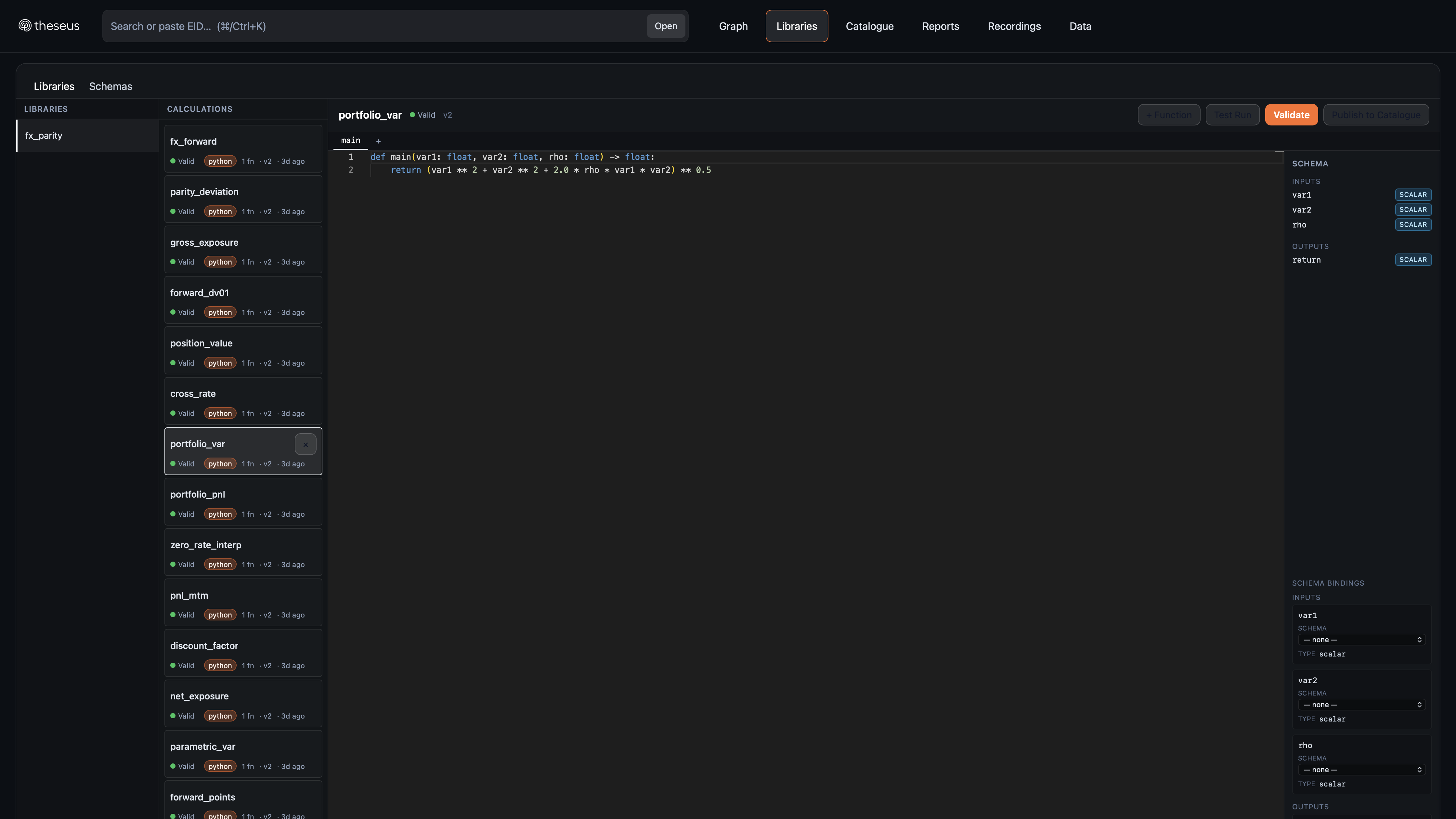
Select live feeds, enterprise systems or APIs, or start with simulated data. Build and test the full application before a single live input is at stake.
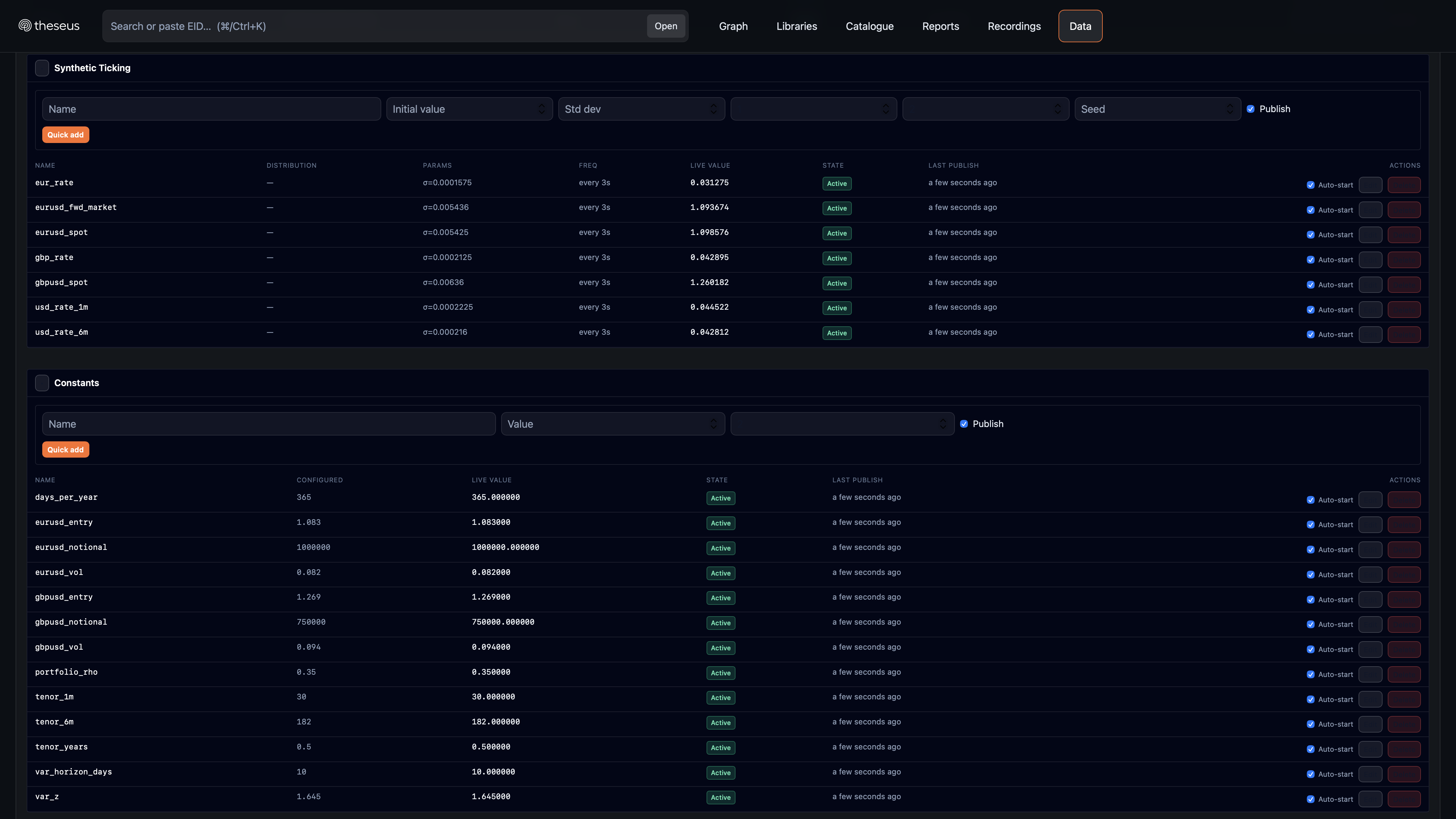
Write pricing, risk or decision logic in the language your team uses. Every calculation is a versioned, testable module.
Drag, drop and link data sources to calculations. Every node is visible. Every dependency is explicit. What you see is what runs.
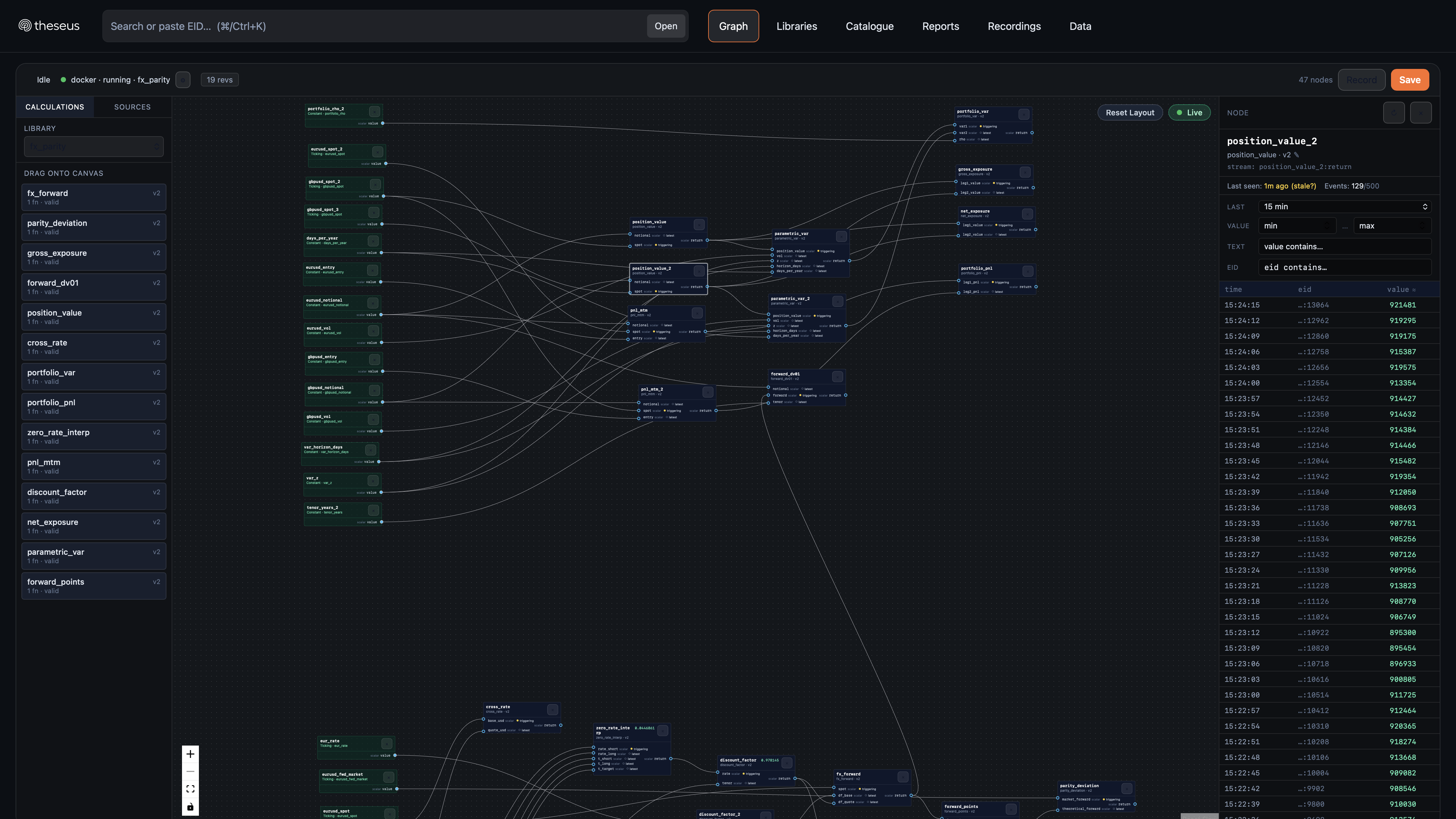
The full application on one canvas. Sources feed calculations and calculations feed the outputs that views consume, with every connection a declared dependency. The structure you compose is exactly the structure the runtime executes. Nothing runs off the graph.
Create dashboards and reports on any node in the graph. End users adapt and customise their own views without raising a ticket or waiting on developers.
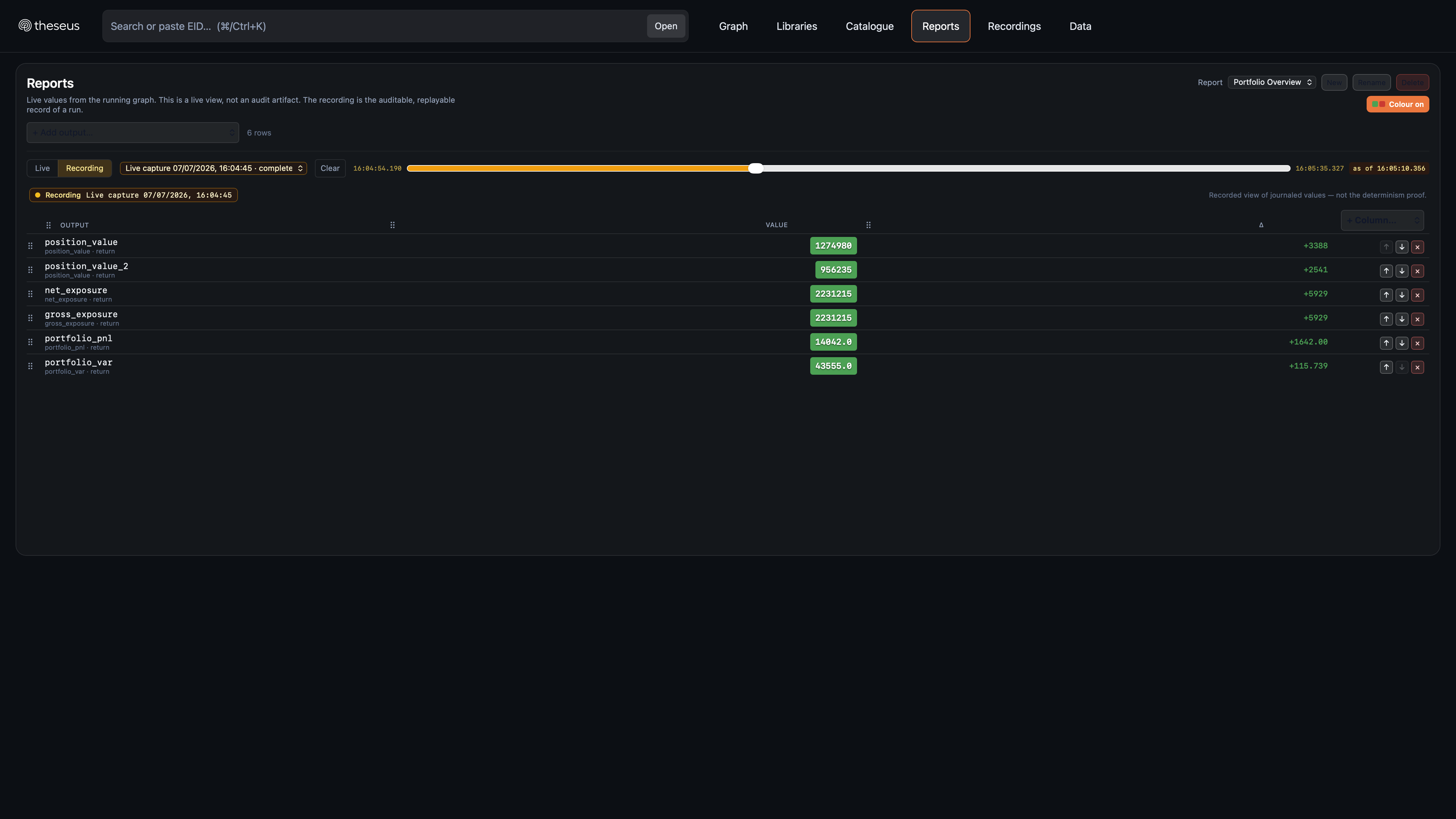
A report built directly on graph nodes. Each figure on screen is a node's output, carrying the same lineage as everything else in the runtime. Users add, rearrange and adapt their own views in place, so a new cut of the numbers is a few clicks rather than a change request.
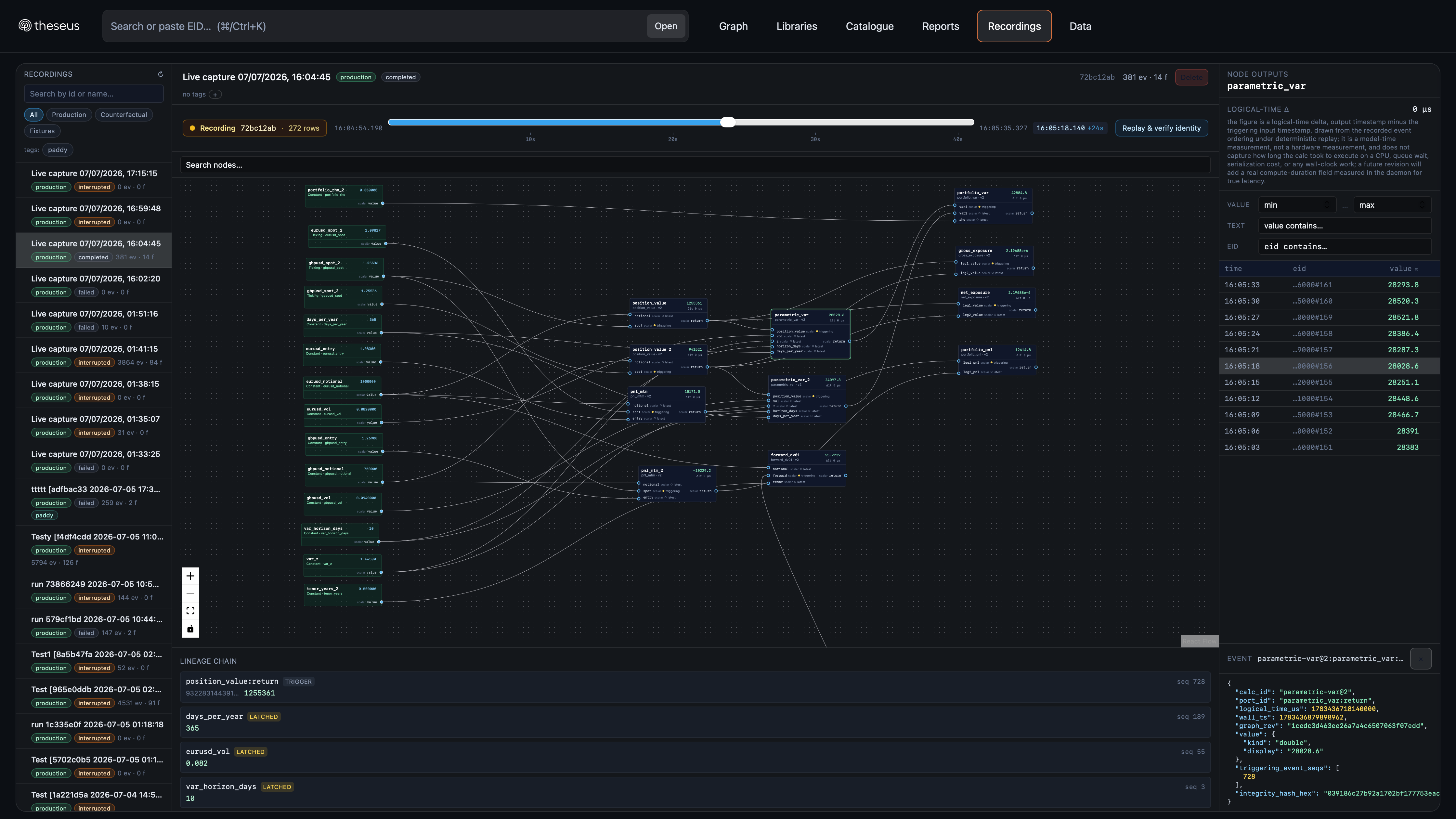
The runtime records the graph as it runs: every input, every state change, every output. Replay the graph state at any moment and see exactly what the system saw. Debugging that used to take days of log archaeology takes seconds, because the answer is exact rather than assembled from interviews and log fragments. Fix the fault, then deploy it without stopping production. The same record is your audit history, complete by construction, written by the system as it ran rather than rebuilt after the fact.
Logic modules are versioned, promoted and rolled back through a governed pipeline, and changes go live without stopping production. Every deployment creates an auditable record. Teams move faster because the platform absorbs the risk that used to demand manual coordination across three to five teams. One team owns build, test, deploy and run, with no queue between an idea and production.
Every data source, calculation, graph and dashboard is a reusable component. Teams share them across systems, desks and regions instead of rebuilding them, so when five teams need the same calculation, they run the same component rather than five private copies drifting apart. Duplication is not something you clean up later. On Theseus, it never accumulates.
Full deployment within your own data centre. Maximum control over data, compute and network. No external dependencies, no shared tenancy, no data leaving the perimeter.
Deployed into your own cloud tenancy with standard security and network controls. Isolated infrastructure; no multi-tenant SaaS.
Lightweight deployment for latency-sensitive or remote environments where decisions must happen close to the data source. Minimal footprint, full determinism.
Combine deployment models across environments where operational or regulatory requirements differ. One platform, one set of guarantees, multiple deployment postures.
Multi-tenant SaaS is not offered. Isolation is a requirement in regulated environments, not an afterthought.
Theseus is domain-neutral by design. Theseus Capital Markets applies the runtime to trading and risk. The same primitives serve energy, defence, payments and insurance workloads without rebuilding the runtime.