
Theseus Capital Markets replaces fragmented desk tooling with a single governed runtime. Deterministic execution, full lineage, self-serve change control, and decision latency of microseconds to milliseconds, target for qualifying production workflows. Built for buy-side and sell-side operations.
A single change touches three to five teams: dev, quant, risk, ops and compliance, coordinated by hand. Request to production takes two to six weeks, and the audit trail is incomplete throughout. After an incident, evidence is rebuilt from logs, spreadsheets and email trails. All of it runs on a per-desk tooling stack that was assembled, not designed.
Theseus figures are design targets. Every parallel-run pilot validates them on your workflows before anything touches production.
Theseus Capital Markets covers the core operational surface of a trading desk: pricing, risk, limits and data transformation. Each workflow is deterministic, auditable and governed from a single platform.
Deterministic price calculations across instruments and scenarios. Market move to desk response with no hidden state and full lineage on every output.
Continuous risk assessment with versioned logic and complete execution lineage. Every risk figure is traceable to its exact inputs and the model version that produced it.
Automated, governed limit enforcement with instant breach alerting. Rules are versioned, auditable and visible to compliance, not buried in application code.
Deterministic data pipelines feeding operational logic. No silent transformation failures. No discrepancies between what the desk sees and what risk is using.
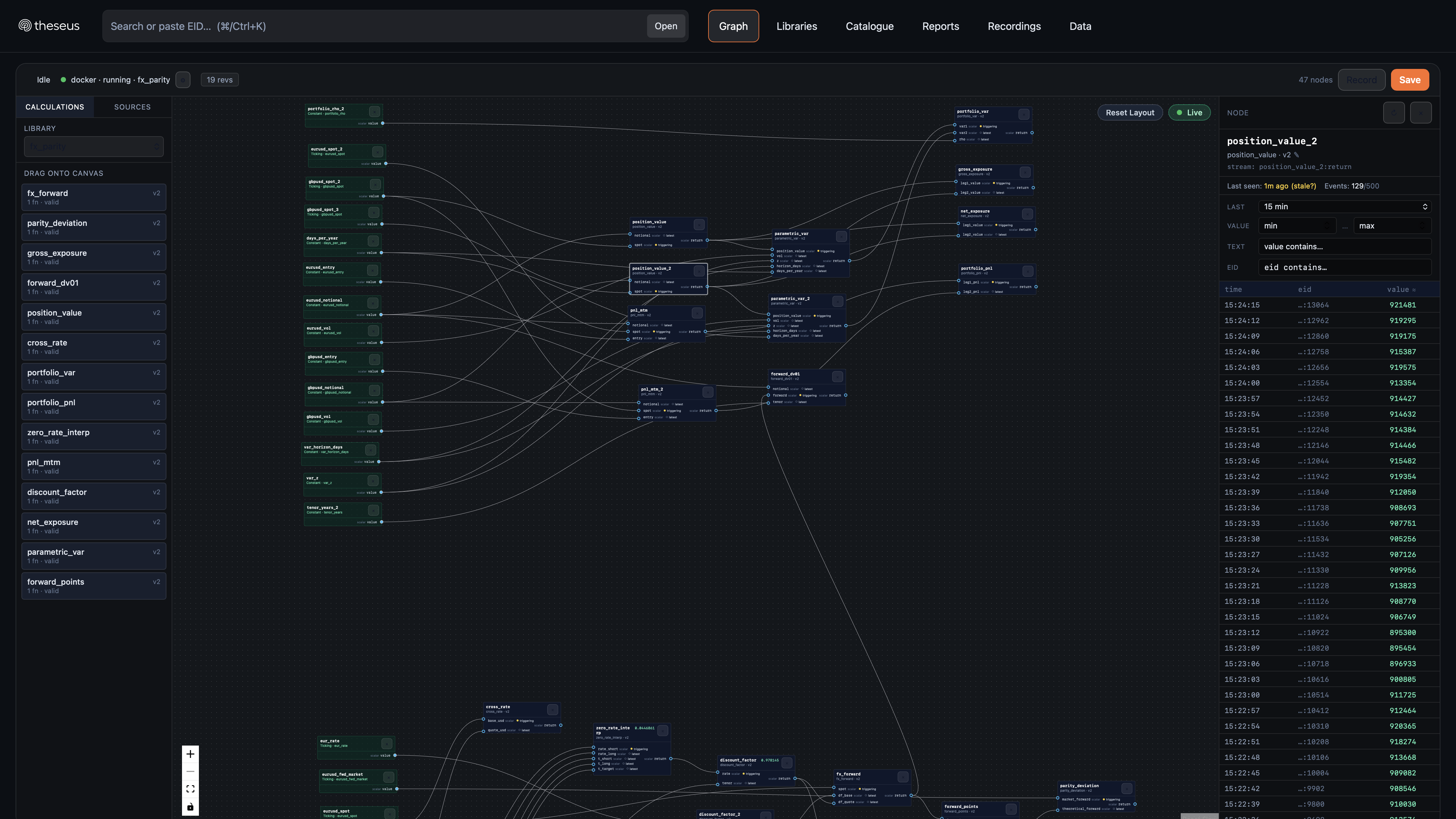
Strats and quants connect market data or simulate it, write calculations in the languages they already use, and compose them into a live application by linking nodes in a graph. Traders adapt and customise their dashboards themselves, with no developer queue and no ticket. Risk and compliance read the record the system wrote as it ran, not a reconstruction assembled afterwards.
When a number looks wrong, replay the graph at the exact moment in question, find the cause in seconds, and ship the fix without taking the desk down. And every component built for one desk can be shared with the next, so the same curve, the same limit logic and the same dashboard never get rebuilt twice.
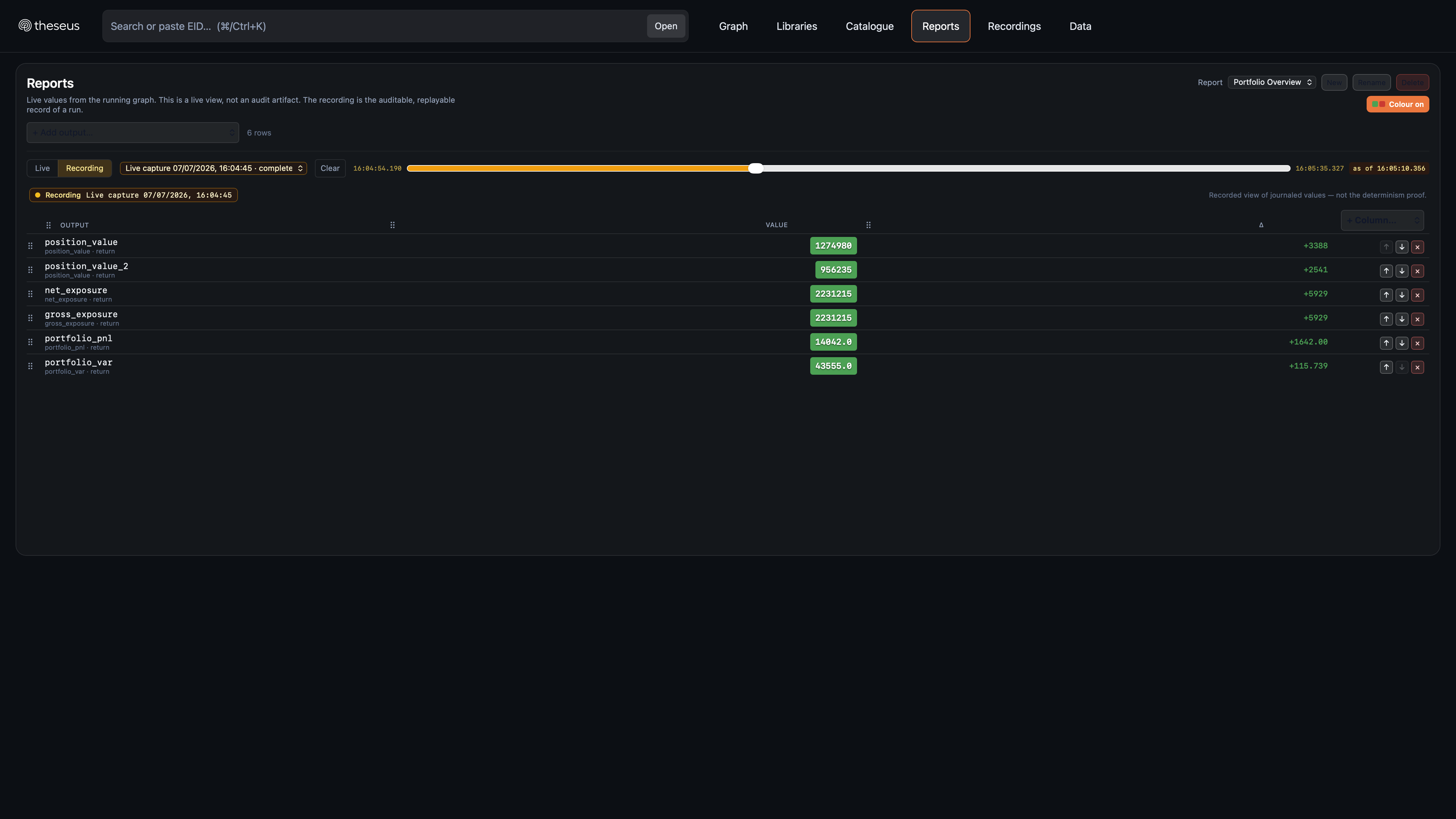
Every pilot runs Theseus Capital Markets in parallel with your existing stack and reports three things: decision latency, change lead time and audit completeness against the legacy system. If the numbers do not hold on your workflows, you will know early. So will we.
Trading and risk combines the tightest latency budgets, the strictest audit obligations and the most public cost of failure of any sector. Control failures draw nine-figure fines. If the platform holds here, it holds anywhere. Finance is the beachhead, not the ceiling.
On-premises, private cloud and edge. Multi-tenant SaaS is not offered. Every production deployment is isolated by design, which is a requirement in regulated environments, not an afterthought.
Calculations run as sandboxed WebAssembly modules inside a single runtime that owns scheduling, event ordering and every input a module can observe. Nothing reaches your logic except through the recorded event stream, so there is no wall clock, thread timing or hidden I/O to diverge on. Every run is journaled, and any recording can be re-executed and checked for identical outputs, so the guarantee is verified on real runs rather than assumed.
Theseus Capital Markets targets microseconds to milliseconds for end-to-end decision latency on qualifying production workflows. Exact figures depend on logic complexity and deployment topology, and every pilot measures them on your workflows rather than ours. A qualifying workflow is one whose full decision path runs inside the runtime, from recorded input to produced output, without a round trip to an external system.
Logic changes are self-serve, versioned and governed. Every promotion creates an auditable record. Teams can deploy, roll back or replay any logic version independently, without waiting in an engineering queue.
No. Design partner pilots run in parallel with your existing systems. Theseus Capital Markets receives the same inputs, runs the same logic, and its outputs are measured against the legacy stack. Nothing is switched over during the pilot.
The parallel run deploys into your environment, on premises or in your own cloud tenancy, inside your network and access controls. Market data, positions and outputs stay within your perimeter. When a pilot ends, the deployment is decommissioned and its data deleted.
Calculations are ordinary functions compiled to WebAssembly, so the runtime is language-neutral by design. Python is supported today.
Inbound adapters capture market data and internal system events with timestamps at the boundary. Outbound, every node's outputs are available as streams and APIs to downstream systems. During build and test, synthetic ticking sources and constants stand in for live feeds.
They enter as recorded inputs. Clocks, seeds and external events are captured in the event stream, so logic observes them as data rather than ambient state, and a replay sees exactly the same values.